Academics - The Prisoner’s Dilemma
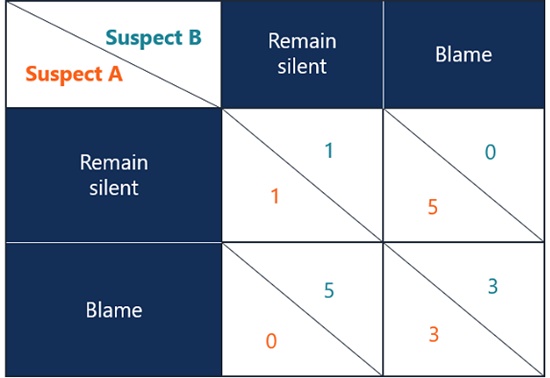
Brian and Nathania are found at a crime scene. Given the physical evidence, they’re each
looking at one year in prison. However, the cops want more than that. They take Brian and
Nathania to separate holding cells and present them with two choices: either testify against the
other or remain silent. If one of them chooses to testify and the other remains silent, then the
testifier is going to be given full immunity while the other is going to be sentenced to five years
in prison. If both parties testify, they’ll each be charged with a prison sentence of 3 years. Of
course, they both could just remain silent and go to prison for one year each. Both suspects are
told that their alleged partner is presented with an equivalent deal. A little while later the police
have testimonies from both Brian and Nathania - why?
This scenario is known as the prisoner’s dilemma, and it’s a classic example of game theory. By
modelling potential interactions between people, we can understand why rational beings
sometimes make choices that seem counter-intuitive.
Taking Brian’s perspective, we can see that he has no reason to believe that Nathania isn’t going
to take the attractive immunity deal. If she talks, it’s in his best interest to talk too and if she
stays silent, talking is still his best option (he’ll get off with no jail time). Since he can’t control
Nathania’s decisions, testifying against her is the smartest choice he can make.
In the same way, Nathania’s perspective can also be devised.
Therefore, both of them will end up testifying against each other even if the better choice,
collectively, would be for both of them to remain silent and get one year of prison time each.
This happens because the situation isn’t in a cooperative environment. Both of them want to win
and they win by betraying each other.
The prisoner’s dilemma always occurs because the two groups can’t communicate. If they’re
allowed to speak, the chances of them backstabbing each other decreases dramatically because
the game stops being competitive. Rational individuals are willing to compromise if it’s ensured
that they won’t lose.
R. Sathyavani
II B.Sc.